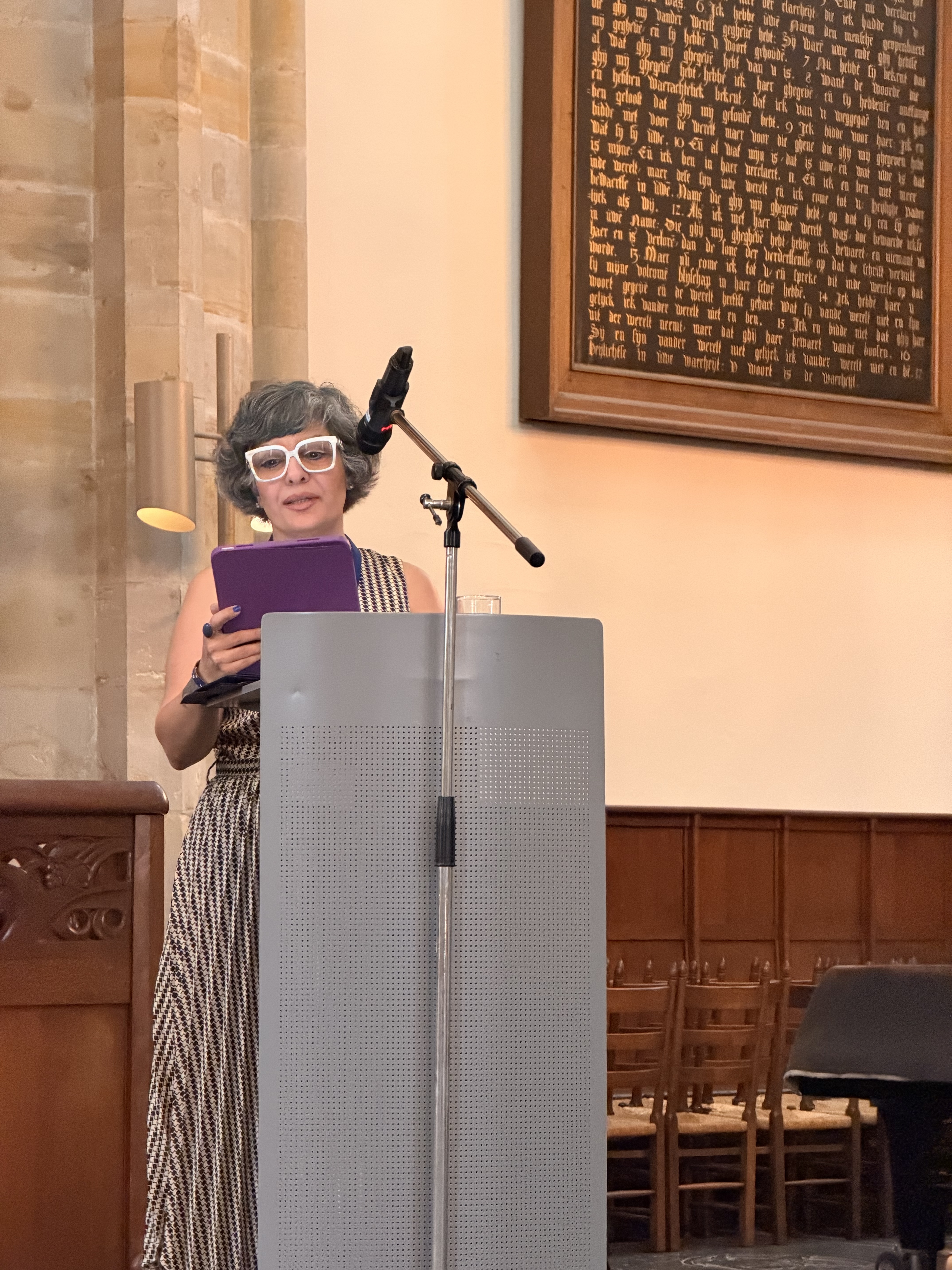
I am an Iranian Armenian American scholar whose work brings together Persian, Iranian, and Armenian cultural studies, gender and sexuality studies, and diaspora studies. Across my research, teaching, leadership, and public humanities work, I return to a set of related questions: Whose stories are told? Whose experiences remain at the margins? And how can the humanities create space for voices and communities that have too often been overlooked?
My intellectual journey began with classical Persian literature and Sufism, where I studied questions of subjectivity, difference, and transgression. Over time, my research turned increasingly toward gender, sexuality, power, and social marginalization. More recently, my work has focused on Iranian Armenian communities and the ways minority identities are transformed across migration, language, generation, and place. My current research brings these interests together by recovering the voices and experiences of Iranian Armenian women whose lives have crossed revolution, migration, and diaspora.
These questions also shape how I teach. I encourage students to encounter Iran and the Middle East through literature, film, cultural expression, and individual lives, not only through the familiar frameworks of conflict and geopolitics. The classroom, for me, is a space to encounter complexity, ask difficult questions, and be open to perspectives that may challenge what we think we know.
My academic leadership has grown from similar commitments. At UNC, I have worked to build the Persian programs, fellowships, research opportunities, conferences, and collaborations. Leading academic communities through periods of political and social upheaval has also changed how I understand leadership: less as directing an institution than as taking responsibility for a community and creating conditions in which people with different experiences and perspectives can remain in meaningful conversation.
Across these different dimensions of my work, a common thread is making space: in scholarship for voices that have received too little attention; in the classroom for difficult conversations and new ways of seeing; in academic institutions for programs and communities to grow; and in public conversations for the human complexity that political narratives often leave out.
Academic Background
University of North Carolina at Chapel Hill
Roshan Distinguished Professor of Persian Studies, 2024–present
Professor of Persian Studies, 2023–2024
Roshan Associate Professor of Persian Studies, 2020–2023
Roshan Assistant Professor of Persian Studies, 2016–2020
Georgia College & State University
Assistant Professor of English and Rhetoric, 2013–2016
Affiliated Faculty, Women’s and Gender Studies, 2013–2016
Education
Ph.D., Comparative Literature, University of California, Santa Barbara, 2013
M.A., English, California State University, Los Angeles, 2008
M.A., English, Islamic Azad University, Tehran, 1999
B.A., English, Islamic Azad University, Rudehen, 1996

