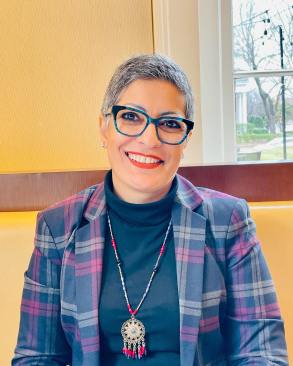
Claudia Yaghoobi is a Roshan Distinguished professor of Persian Studies and serves as the director of the Center for the Middle East and Islamic Studies at the University of North Carolina, Chapel Hill. Yaghoobi is a scholar of Iranian cultural studies, and gender and sexuality studies with a focus on the members of sexual, ethnic, and religious minoritized populations. Yaghoobi’s body of work includes several impactful publications. She is the author of Transnational Culture in the Iranian Armenian Diaspora (Edinburgh UP 2023), Temporary Marriage in Iran: Gender and Body Politics in Modern Persian Literature and Film (Cambridge UP 2020), and Subjectivity in ‘Attar, Persian Sufism, and European Mysticism (Purdue UP 2017). Additionally, she is the editor of a volume titled, The #MeToo Movement in Iran: Reporting Sexual Violence and Harassment (IB Tauris/Bloomsbury Press, 2023). Yaghoobi earned her Ph.D. in Comparative Literature and Feminist Studies from the University of California at Santa Barbara in 2013. Leveraging her extensive knowledge and expertise, she teaches diverse courses encompassing Iranian literature and culture, Middle Eastern literature, gender and sexuality, diaspora studies, and human rights. A true embodiment of her multifaced identity, Yaghoobi identifies as an Iranian Armenian American. Her research encapsulates the literary landscape of the Middle East, with an acute emphasis on Persian and Armenian literature. Particularly, she hones on the experiences of those who belong to sexual, ethnic, and religious minority groups, often positioned at the periphery of normative society. Through her academic inquiry, she delves into the nuanced intersections of liminality as they are expressed by authors, artists, and directors, who valiantly challenge and deconstruct prevailing social hegemonies.
Currently, Yaghoobi is completing her fourth monograph titled, Lives in Translation: Armenian Women’s Voices in Iran and the US, under contract with UNC Press. Lives in Translation delves into the hidden narratives of Iranian Armenian women, a multiply marginalized group shaped by intersecting factors of ethnicity, religion, gender, and class across Iran and the U.S. In Iran, they navigate intersectional discrimination as Armenian Christians and women in a patriarchal society. In the U.S., their identity shifts to racialized “brown” women, and targeted by Islamophobia despite their Christian faith. The study combines autoethnography, oral histories, and archival research to explore how systemic racism, gender discrimination, class stratification, and nationalism shape these women’s strategies of self-preservation and identity negotiation. Drawing from the author’s personal journey—living through post-revolutionary Iran, the Iran-Iraq war, and immigration to the U.S.—and 15–20 oral interviews, the book situates their experiences within significant socio-political contexts, including the 1979 Islamic Revolution and American Islamophobia after 9/11. By highlighting how religion, ethnicity, gender, and class intersect in shaping their lives, Lives in Translation offers a nuanced contribution to global discourses on ethnic and gender studies, nationalism, and identity.
 Claudia Yaghoobi, PhD